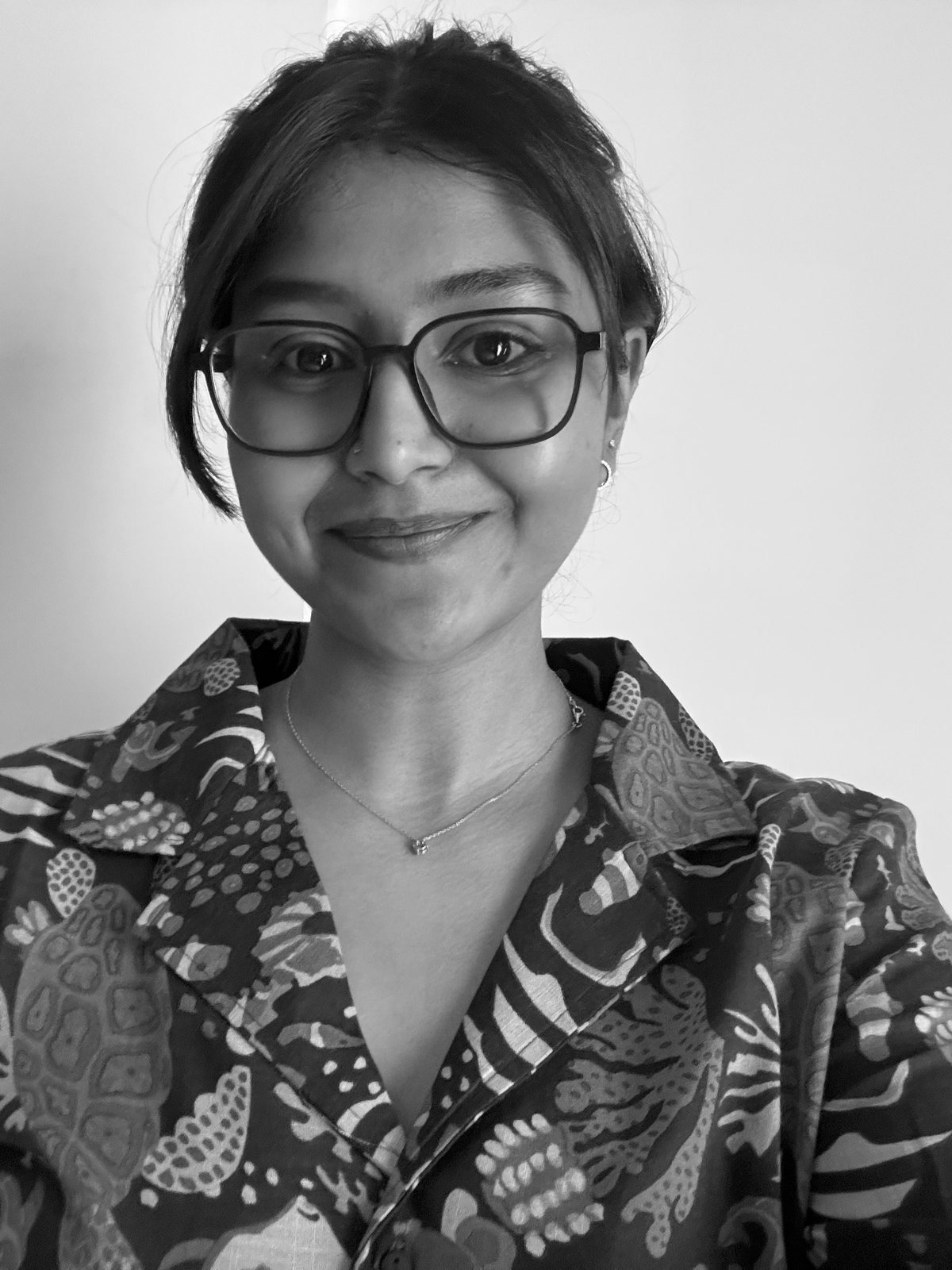
Prathiksha Venkateswaran
I am a counselling psychologist working with adults navigating trauma, attachment patterns, and the complexities of neurodivergence and queer identity. My approach is relational and grounded in an intersectional, feminist-socialist framework. In session, I bring compassion, personal presence, and direct candor, using humor and wit to build understanding and ease. Rather than forcing verbal articulation, I integrate art-based practices alongside CBT, EFT, and somatic therapy to open up organic conversation when words feel inadequate. I offer therapy in English, Tamil, Kannada, and Hindi.
What I believe therapy is for.
Therapy is not about “fixing” or fitting into normative standards; it is about making sense of your responses in a complex world. Real change happens when we drop the belief that we are “weird” or “difficult” and look clearly at how systemic pressures and past relationships shape our present survival strategies.
In my practice, my job is to make room for heavy material through conversational ease, wit, and art-based practices when words fall short. Your job is not to perform recovery or produce immediate answers, but to show up with honesty and compassion for yourself. Therapy succeeds when you stop fighting your own wiring and start navigating life with self-trust.

The first session.
Think of our first session as a two-way conversation to see if we’re a good fit. We’ll talk through what’s going on, what you’d like to work toward, and your past experiences with therapy, strictly at your pace, revealing only what feels okay to share. Just as importantly, it’s your chance to put me in the hot seat: ask me who I am, what I’d like to do outside work, or how I work. By the end, we’ll map out our rhythm, agree on scheduling, and decide together where we go from here.
Whether we are a good match.
Who I work best with
- My practice lands best with adults who find standard, talk-only therapy limiting and want an active, relational partner in their care. I often work with:
- People navigating trauma, attachment patterns, neurodivergence, or queer identity who are tired of explaining or defending their lived experience.
- Partners or couples struggling with communication, attachment ruptures, or feeling stuck in traditional relationship expectations.
- Individuals who experience burnout from constant masking or social demands.
- People who get stuck in their heads during traditional therapy and need alternative practices to access hard feelings.
Where I may not be the best fit
Because client safety and clinical alignment are my top priorities, my practice is not equipped for active psychiatric crises, severe psychosis, or acute suicidality requiring immediate medical intervention or intensive, higher-level care.
Similarly, if you are looking for a purely structured, advice-giving setup or quick diagnostic solutions without exploring relational or creative processes, my approach may not match what you need.
The things people bring me.
Primary Focus (core caseload & deep experience)
- Anxiety, chronic stress, and overwhelm
- Trauma and complex trauma
- Relational and attachment dynamics (individuals and couples)
- Neurodivergence (ADHD, Autism) and neurodivergent burnout
- LGBTQIA+ and queer identity exploration
- Emotion regulation and distress tolerance.
Secondary Focus (competent, lower volume)
- Systemic and social power dynamics
- Somatic awareness and body-based grounding
- Social anxiety and masking fatigue
- “I feel like I’m constantly on edge, overthinking every decision, and waiting for the other shoe to drop.”
- “I am completely exhausted from pretending all day just to fit in.”
- “I keep having the same painful talks with my partner, and we end up running in circles.”
- “I know I have things to process, but whenever I try to talk about it, my mind goes completely blank.”
- “I’m tired of having to explain or defend my identity or choices to the person who is supposed to be helping me.”
- “I feel this knot in my body that won't go away, even when nothing really feels wrong.”

The shape of the work.
Modalities I use
- Emotion-Focused Therapy (EFT): Helps you make sense of deep feelings and relationship patterns instead of just reacting to them.
- Somatic awareness: Helps you tune into physical tension and body signals to build a sense of calm and stability.
- Art-Based therapy: Uses simple creative tools to express feelings when talking out loud feels hard or overwhelming.
- Cognitive Behavioral Therapy (CBT): Looks at how your thoughts influence your mood and actions so you can break stressful overthinking loops.
Session style
I am semi-structured and active in the room. We usually begin by checking in on what feels most pressing, while keeping sight of your overarching goals so we do not just spin our wheels reacting to weekly crises. I share observations directly, but always collaboratively. If we explore things to try between sessions, we design them together so they feel doable. If you need to exist in silence, I will not push it away, I let silence hold space and grow as big as it needs to, offering gentle somatic check-ins when you are ready to ease back in.
Longer work
Long-term work usually starts with finding your footing in current challenges before we turn toward the root patterns driving them. Once we understand those layers, we focus on integrating real-life changes into your daily routines. We check in regularly on our progress so our direction stays intentional, and I will be open when it feels time to taper sessions down. Ending therapy is never abrupt - unless we realize we aren’t the right therapeutic fit, we carefully plan our termination together, weaning off sessions so you feel grounded as you transition.
What I actually have experience with.
Working with LGBTQIA+ clients
As a queer person, I have walked this path myself, from figuring out my identity and grappling with feelings told to be "impure," to building confidence in my expression. In the space that we share, you do not have to perform or defend your lived experience. We are all human here. Professionally, I guide clients through normalizing bodily changes, managing minority stress, and making meaning with found families while navigating unaccepting family dynamics. This is a shared space rooted in understanding, somewhere you can simply exist.
Working with neurodivergent clients
As a late peer-diagnosed AuDHD therapist, I view my room as a shared, informed space rather than a place to pathologize how your brain works. I work therapeutically with self-identified and formally diagnosed adults, focusing on neurodivergent burnout, masking, and sensory strain. Nothing in our process is assumed or imposed. We explicitly converse and agree on pacing, emotional processing, session structure, and home practices, ensuring our work adapts flexibly to your energy, communication style, and executive function needs without forcing conformity.
Trauma
I work extensively with sexual trauma, childhood trauma manifesting as unhealthy behavioral patterns in adulthood, and developmental trauma. My priority is nervous system stabilization and helping clients reconnect comfortably with their bodies using somatic awareness and Emotion-Focused Therapy (EFT). We focus on building somatic tolerance and safety before processing heavy material. When natural pauses or silences occur in conversation, I integrate art-based practices to ease dialogue and allow organic exploration. Processing happens gradually, ensuring clients feel anchored without overwhelming their system or forcing verbal articulation when words feel inadequate.
Couples and relational work
I work with couples across all relational stages; whether you are beginning a partnership, feeling stuck in repetitive conflict loops, or navigating a mutual termination. My practice integrates Emotion-Focused Therapy (EFT), attachment-based relational principles, and Gottman-informed methods. Together, we focus on de-escalation, dismantling rigid boundaries to build safety, and establishing mutual systems and routines that support both partners. My practice is explicitly inclusive of queer couples, though I do not work with polyamorous configurations at this time.
Training, registration and practicalities.
| Qualifications | M.Sc. Clinical Psychology - Manipal University Jaipur, India (2024) B.Sc. Psychology - Stella Maris College, Chennai, India (2021) |
|---|---|
| Registration | As there is currently no statutory licensing register for counselling psychology or art therapy in India, I practice in accordance with the ethical frameworks and professional standards of IEATA (International Expressive Arts Therapy Association) |
| Certifications and further training | Art-Based Therapy Practitioner Certification - Montfort College, Bengaluru (2021) | Completed Queer Affirmative Counseling Practice Certification - The Psyklife (2024) | Completed Trauma-Informed Care Practitioner Certification - Hansraj College, University of Delhi (2024) | Completed |
| Years of experience | I have 2.6 years of post-qualification clinical experience working across private practice, school settings, and online mental health platforms. |
| Supervision | I work under ongoing, professional clinical supervision to hold high ethical standards, reflect on client work, and ensure my trauma-informed practice remains grounded and accountable. |
| Languages | I work in English, Tamil, Kannada, and Hindi; Fluent and fully equipped to conduct and hold therapeutic sessions in all four languages. |
| Online or in person | I practice fully online to prioritize long-term continuity, broad accessibility, and affordability; ensuring care remains uninterrupted regardless of future relocations. Online therapy is real, effective therapy. It offers a private, familiar environment where we can engage in deep relational work, active dialogue, and creative practices just as effectively as in a physical room. |
| Availability and fees | I am currently accepting new clients, with individual sessions available on Mondays, Tuesdays, Fridays, and Saturdays, and Sundays reserved exclusively for couples therapy. To accommodate clients living outside India across international time zones, I offer early morning appointment slots. My session fees are ₹1,850 for a 60-minute individual session and ₹2,800 for a 90-minute couples therapy session. I also offer sliding-scale fee slots upon request for individuals from structurally marginalized communities. |
What sits behind how I practise.
What I value in the work
My practice is politically feminist, socialist, and deeply rooted in my lived experience as a neuroqueer person. My roots built my branches: watching patriarchal dynamics silence people in my own family taught me to treat therapy as my quiet act of rebellion. In our sessions, I refuse to let systemic harm or marginalization be minimized. I bring personal truth, empathy, and radical candor into the room, advocating for your right to a great quality of life where you never have to defend who you are.
Books that shaped how I work
- The Lord of the Rings by J.R.R. Tolkien: Reading this with the knowledge of Tolkien’s lived experience as a war veteran completely shifted how I view the relationship between art, myth, and processing deep trauma.
- Neurodivergent by Nature by Joe Harkness: rounded my understanding of how neurodivergent people relate to, connect with, and thrive within earth’s natural ecosystems.
- (Recommended) Good Omens by Neil Gaiman and Terry Pratchett: An eye-opening, witty, and humorous treasure trove for amateur philosophers that gently challenges rigid moral binaries and reminds us that whatever is written can always be crossed out.
If you are in immediate danger or worried you might act on thoughts of harming yourself, please contact Tele-MANAS (14416 or 1-800-89-14416, available 24×7 across India) or your local emergency services.