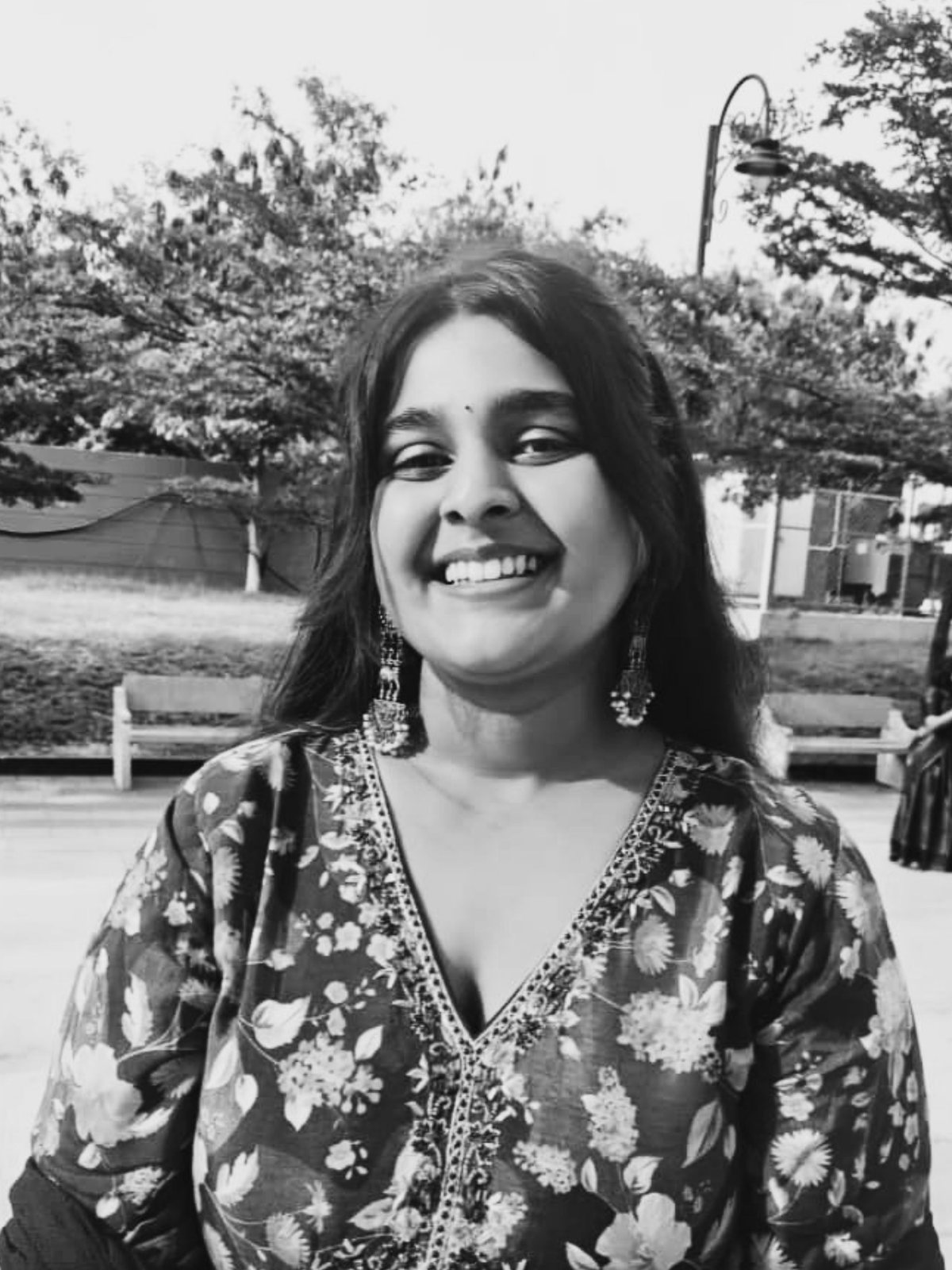
Trisha Jain
I am a psychologist working with young adults on anxiety, overwhelming emotions, motivation, and boundaries. In sessions, I like to be direct, ask questions that help you get closer to what you actually feel, gently challenge your own patterns, and, just as importantly, be kinder to yourself along the way.
What I believe therapy is for.
I see therapy as a space that lets each of us understand and make peace with our experiences, rather than measuring ourselves against society's idea of an "efficient" human. I believe real change begins with awareness, which comes through learning about ourselves; why we feel what we feel, and how our minds have come to work the way they do. Once that understanding settles in, it starts reshaping the narrative: how we relate to what's coming, and how we hold our past. Therapy, to me, isn't about becoming someone new. It's about finally recognising who you've been all along and choosing what to do with that.
What therapy feels like with me.
Sessions with me are active and collaborative, think less lying on a couch, more thinking things through together. I use role-play, reflection, and writing things down in the moment, so ideas and feelings don't just float away. I'll bring in a resource or a framework when it adds clarity, and not rush past a feeling that surfaces just because it's uncomfortable; we sit with it, name it, work through it. Sessions usually end with a question or a thread to sit with until next time, so the thinking doesn't stop when the session does.

The first session.
Our first session is just about getting to know each other and seeing if it feels like a good fit for each other. I'll ask what's been weighing on you lately, but nothing is compulsory; if a question doesn't feel right yet, simply skip it, no explanation or justifications required. Think of it as a casual chat, and not an interview. We'll close by talking about how it felt and mapping out what comes next, together.
Whether we are a good match.
Who I work best with
- You have been the strong one in your family for so long, nobody thinks to ask if you're okay.
- Your inner monologue is kinder to strangers than it's ever been to you.
- Saying no feels extremely difficult, so you don't, until resentment does the talking instead.
- You can read a room in seconds but take days to figure out what you feel in it.
- Achievement has never quite translated into feeling like enough, no matter how much you stack up.
- You're tired of being easy to be around and hard to know.
- The unsettling memories with parents, teachers, friends from childhood still trouble you deep down
Where I may not be the best fit
As a starting therapist, I am not the right person for severe mental health illness or emergencies needing urgent psychiatric care, that needs faster, in-person support, and I can help you find the right team for it. I don't currently work with children, couples, or medical gender-affirming pathways; colleagues who specialise there would serve you better. And if you're looking for someone who mostly listens quietly as you vent, then I likely won't be the best fit as I tend to ask, challenge, and stay fairly involved in the room.
The things people bring me.
- Primary areas: self-confidence and self-worth, assertive communication, boundaries with family, overthinking emotion regulation, stress-related physical symptoms, motivation and work-related stress, and people-pleasing patterns.
- Secondary areas: queer-affirmative therapy, body-image issues, rumination, early relationship difficulties, and sleep difficulty.
- I work with people who have never quite believed their own feelings were allowed to matter as much as everyone else's.
- “I don’t know what’s wrong with me”
- “I don’t know who I am”
- “I want to become more independent”
- “I want to learn to keep my emotions in control”
- “I want to feel at ease”
- “For once I want think about myself”
- “I want to feel good about myself”
- “I want to stop saying yes to everyone”

The shape of the work.
Modalities I use
Eclectic approach
Session style
I come prepared, often with a few questions in mind, so we can build on what we've talked about before. Together, we'll question your thoughts and feelings, looking at them from different angles to understand you better. I may introduce small exercises to help with what's been affecting your day-to-day. And silence? Whenever you need it. I'll just make sure we come back to it, not avoid it."
Longer work
Over time, our work moves beyond just coping, it focuses on understanding why certain patterns exist and what shifts when you plan on actively working on them. However, not everything needs fixing; sometimes growth looks like making room to simply let things be, without rushing to change them. Every few sessions, we pause together to notice what's helping and what needs adjusting. Slowly, we'll get clarity on how long and how often we need to meet. Above all, I aim to work collaboratively, honestly, and at your pace.
What I actually have experience with.
Working with LGBTQIA+ clients
I understand the weight Indian queer clients often carry, with families who love you but won't say the words, the exhaustion of being out in some rooms and closeted in others, and the legal and social landscape that shapes how safe any of that feels. I'm comfortable working through coming out, chosen family, and minority stress, and I hold space for early questions around gender identity as they come up. When a client needs medical gender-affirming care, I connect them with colleagues who specialise in that.
Couples and relational work
Individual work only
Training, registration and practicalities.
| Qualifications | Master of Science in Applied Psychology (Clinical Specialization)- MAHE, Bengaluru, 2026 Bachelor of Arts in Psychology, Journalism and Literature- Jain (Deemed-to-be) University, Bengaluru, 2023 |
|---|---|
| Registration | Not applicable |
| Certifications and further training | Not applicable |
| Years of experience | Not applicable |
| Supervision | I am under active supervision, once every week with Lenni George, an experienced Counselling Psychologist and founder of Fenweh Mental Health. |
| Languages | English and Hindi |
| Online or in person | I work in an online set up which makes showing up for clients easier and more accessible from wherever they are and encourages them to be more consistent with sessions. |
| Availability and fees | I'm available for sessions Monday through Saturday, with three windows to choose from each day: 10:00 AM-1:00 PM, 3:00 PM-5:00 PM, and 6:30 PM, 9:00 PM (IST). Each session runs 50 minutes, giving us focused, unhurried time to work together. The fee per session is 750 rupees. I also offer a limited number of concession slots for those who need financial flexibility - feel free to reach out to check current availability. |
What sits behind how I practise.
What I value in the work
being unassuming of an individual as everybody has different upbringing, experiences and approach in life.
To be kind to oneself and allowing to learn something by being less critical.
Books that shaped how I work
- The Heart Lamp by Banu Mushtaq helped me understand the reality of the Muslim community especially those experienced by Women and young girls which deeply impacts their health and quality of life.
- The last lecture by Jeffrey Zaslow & Randy Pausch: the author focuses on living the to not be hesitant to achieve their dreams even after various obstacles. The one line that stayed with me is to not be hesitant to ask, make mistakes and be concerned about other’s opinion as that would just lower our efficiency. It helped me to improve my communication and not build a castle of assumptions.
- Tuesdays with Morrie by Mitch Albom was a very warm and reflecting book on life back when I read during my bachelor’s, and it helped me to look at life with a bit more of optimism and normalized death of a person as it’s a very natural process just like being born.
- I am currently also reading the ‘Tell-tale of the brain’ which is an extremely interesting dive into our fascinating brain and experiments done to understand how our brain perceives the world and helps in functioning.
Research, writing and talks
My research interest lies more into the field of health psychology, evolutionary psychology, eating disorders, parenting and trauma. I am currently working towards publication of my master’s thesis, on the topic: “Cultural food customs and beliefs related to orthorexia nervosa: An exploratory study among Indian Young Adults.”
Answered in my words.
If you are in immediate danger or worried you might act on thoughts of harming yourself, please contact Tele-MANAS (14416 or 1-800-89-14416, available 24×7 across India) or your local emergency services.