
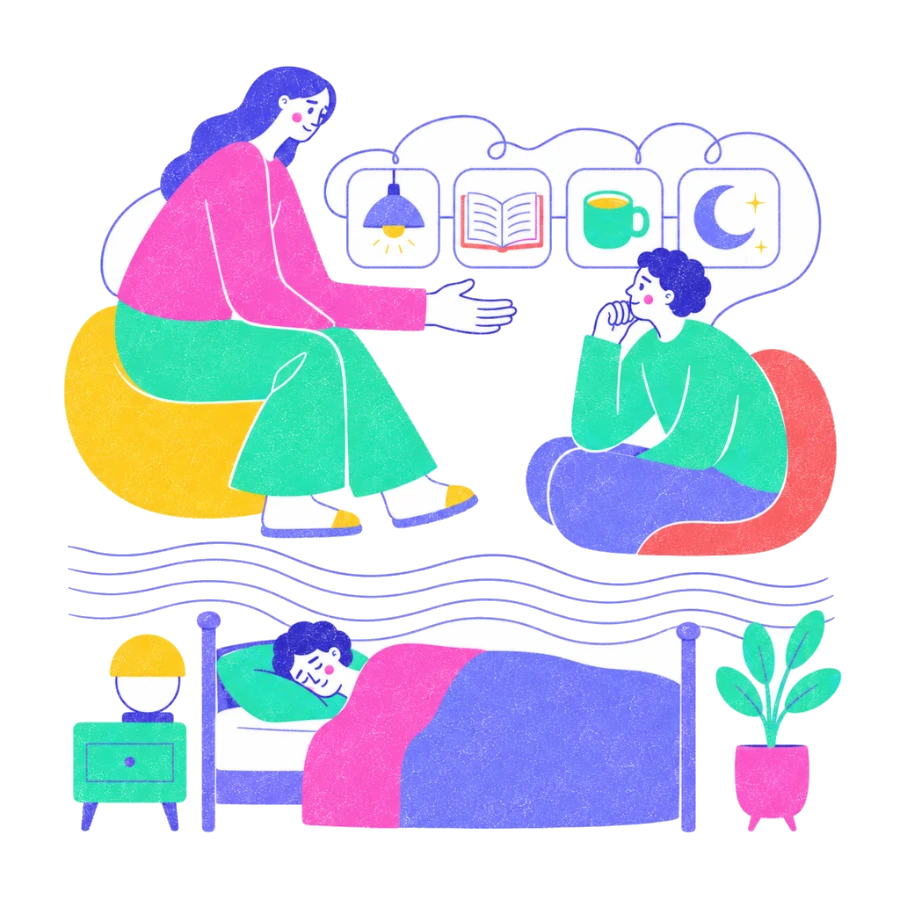
Your mind is not keeping you awake. It is finally getting the first quiet hour of your day.
You are exhausted at eleven. By half past twelve you are wide awake, thinking about a conversation from March.
Most persistent sleep trouble is not a sleep problem on its own. It is an unprocessed day arriving at the only hour nobody is asking anything of you, plus a set of habits built to cope with being tired. Sleep responds well to therapy, particularly to the behavioural approach, and it usually improves faster than people expect once the rules stop being about willpower.
The only hour that belongs to you
If your day runs from the first message to the last request, bedtime is the first unclaimed time you have had. A mind that has been managing tasks for sixteen hours does not switch off on cue. It starts, finally, to process. That is not malfunction. That is a backlog clearing at the only moment available to it.
This is also why scrolling until two in the morning is so hard to stop. It is not really about the phone. It is the only stretch of the day that nobody else has a claim on, and giving it up feels like giving up the last thing that was yours.
Trying harder makes it worse
Sleep is one of the few things that gets further away the more effort you apply. Lying in bed determined to sleep converts the bed into a place where you fail at something, and after a few weeks your body starts to treat the bedroom as a site of pressure rather than rest.
Which is why the treatment can feel counterintuitive. Often it involves spending less time in bed rather than more, and getting up when you are not sleeping instead of persevering.
Sentences people say in a first session.
"I am tired all day and awake at night."
A rhythm that has inverted, usually with a reason behind it that is worth finding.
"I go to bed just to be on my phone."
Not indiscipline. The only unclaimed hour in the day, defended.
"I dread bedtime now."
Once the bed becomes a place you fail, the anxiety arrives before the sleeplessness does.
"I sleep fine on holiday."
Which is useful information. It tells you the machinery works and something in the ordinary week does not.
What we actually do.
The habits, the wind-down, and whatever the 2am mind is trying to finish.
Rebuilding the runway
A wind-down that is realistic for your life, not a list borrowed from someone with no dependents.
Read this →
The 2am replay
Giving the backlog somewhere earlier in the day to go, so it stops arriving at midnight.
Read this →
Getting an evening back
If the day never ends, night has to do too much work. Often this is where sleep is actually decided.
Read this →| A bad stretch | Insomnia | |
|---|---|---|
| Duration | Days | Three nights a week for three months or more |
| Cause | Usually identifiable | Continues after the cause has gone |
| Bedtime | Neutral | Anticipated with dread |
| Daytime | Tired | Concentration, mood and memory affected |
| Effort | Not needed | Sleep has become something you try to achieve |
How therapy helps
- Protect the bed for sleep. Reclaiming it as a place your body associates with rest rather than with effort and failure.
- Fix the rhythm before the duration. A consistent wake time does more early on than an earlier bedtime.
- Move the processing earlier. The 2am review happens because it has nowhere else to go. Give it somewhere at seven.
- Look at the whole day. If there is no boundary between work and evening, night is being asked to absorb everything.
Sleep, answered plainly.

You have been tired for long enough.
Tell us what your nights actually look like. We will match you with a therapist who works on sleep and will not open with advice about chamomile.