
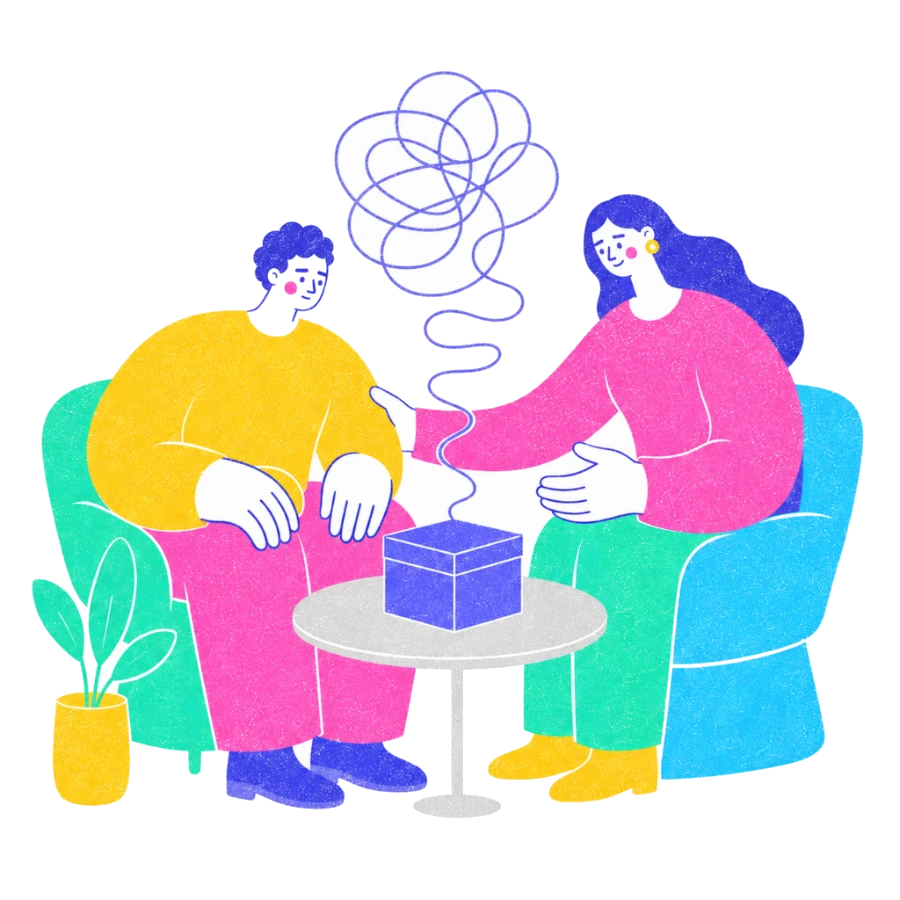
The thought is not the problem. The thing you do to make it go away is.
Checking, washing, repeating, seeking reassurance, praying to a count. Every one of them works for a few minutes and teaches the doubt that it was right to shout.
Exposure and Response Prevention is the first-line psychological treatment for OCD. You deliberately make contact with what triggers the doubt, then do not perform the compulsion that normally follows. The compulsion is the part that maintains the disorder, because the relief it produces is what convinces your brain the threat was real. ERP is demanding and it is also the treatment with the best outcomes by a wide margin.
The compulsion is what keeps it running
Everyone has intrusive thoughts. In OCD, the thought attaches to a doubt that feels intolerable, and something has to be done to settle it. Checking the lock, washing again, replaying the memory, asking someone to confirm you are not a bad person.
It works. That is the trap. Relief arrives within a minute or two, and your brain records that the danger was real and the ritual averted it. So the next doubt arrives louder, and requires more.
The forms nobody talks about
Contamination and checking are the recognisable versions. A great deal of OCD is entirely internal: intrusive thoughts about harm, about sexuality, about whether you love your partner, about blasphemy. The compulsions are mental too, which means nobody around you sees anything.
These forms carry the most shame and are the most likely to go untreated for a decade, because the content feels like evidence about who you are. It is not. Content is noise. The mechanism is the same.
Sentences people say in a first session.
"I know it makes no sense."
Insight is usually intact in OCD, which is part of what makes it so distressing.
"I just need to be sure."
Certainty is the thing being chased, and it is the one thing the ritual can never deliver.
"I cannot tell anyone what the thought is."
Especially the taboo forms. The shame is a symptom, not a verdict.
"I ask my partner to confirm it constantly."
Reassurance is a compulsion. It is often the first one we work on, together with them.
How the work is staged.
Hierarchy first, then contact, then dropping the ritual.
Exposure, then prevention
Making contact with the trigger, then not doing the thing. That second half is where treatment happens.
Read this →
Living with the doubt
Learning that an unanswered question can be left unanswered, which is the actual skill.
Read this →
Family accommodation
Loved ones usually help with the rituals out of kindness. Unwinding that is part of treatment.
Read this →| Intrusive thought | OCD | |
|---|---|---|
| Who gets them | Almost everyone | Almost everyone |
| Reaction | Passes, oddly | Feels urgent and meaningful |
| Response | None | A compulsion, mental or physical |
| After the response | Not applicable | Brief relief, then it returns louder |
| Over time | Nothing | Rituals grow and take over hours |
What ERP is good for
- Checking and contamination. The recognisable forms, and the ones where the hierarchy is easiest to build.
- Purely mental OCD. Where compulsions are internal. ERP still applies, and it is harder to spot without a trained eye.
- Taboo intrusive thoughts. Harm, sexuality, religion. Content that has kept people silent for years and responds to the same protocol.
- Relationship and health doubt. Endless questioning of a relationship or a symptom, treated as compulsion rather than as a real question to answer.
OCD and ERP, answered plainly.
The thought is not evidence about you.
Tell us what the doubt is, or as much of it as you can. We will match you with a therapist trained in ERP.